
Wuwei (无为), often translated as “non-action”, is a fundamental concept in Taoist philosophy and plays an important role in the practice of Tai Chi. It may sound like doing nothing, but wuwei is actually a way of acting without forcing or interfering with natural processes. In this post we explore wuwei through the works of the ancient Taoist philosophers Liezi, Zhuangzi and Laozi.
Understanding Wuwei
At its core, wuwei is about letting go of the ego and allowing things to unfold naturally, without our intervention. It means being aware enough to respond to situations appropriately, without creating resistance or conflict. It is not about being passive, but about actively engaging with the world in a way that is aligned with the flow of nature.
According to Taoist philosophy, all things arise from the Tao, or the Way, the ultimate reality that transcends all dualities. The Tao cannot be described in words, but it can be experienced through direct intuition. To live in harmony with the Tao, we must let go of our desires, judgements and attachments, and be guided by the natural order of things.
Wuwei is a practical concept as well as a philosophical one. It can be seen in the way we move, breathe and interact with others. In Tai Chi, the goal is not to force the movements or achieve a specific outcome, but to allow them to emerge spontaneously from within.
Wuwei in Action
To illustrate wuwei, let’s look at some stories from ancient Taoist philosophers.
Liezi
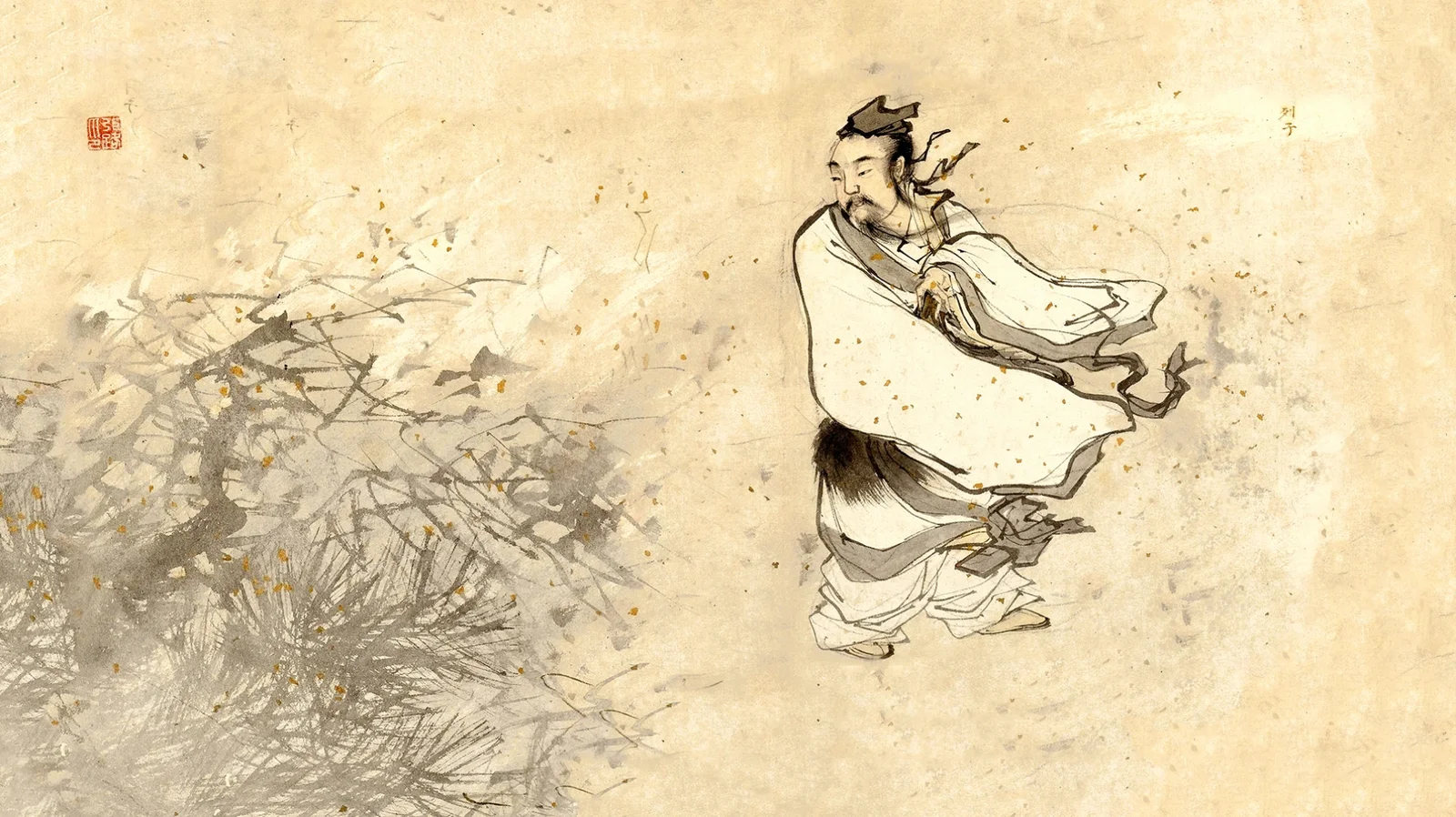
In the Liezi1 there is a story about Liezi riding the wind.
‘At the end of nine years my mind gave free rein to its reflections, my mouth free passage to its speech. Of right and wrong, profit and loss, I had no knowledge, either as touching myself or others. I knew neither that the Master was my instructor, nor that the other man was my friend. Internal and External were blended together into Unity. After that, there was no distinction between eye and ear, ear and nose, nose and mouth: all were the same. My mind was frozen, my body in dissolution, my flesh and bones all melted together. I was wholly unconscious of what my body was resting on, or what was under my feet. I was borne this way and that on the wind, like dry chaff or leaves falling from a tree. I knew not whether the wind was riding on me or I on the wind. Now, you have not spent one whole season in your teacher’s house, and yet you have lost patience two or three times already. {p. 40} Why, at this rate, the atmosphere will never support an atom of your body, and even the earth will be unequal to the weight of one of your limbs!
(The only way to etherealize the body being to purge the mind of its passions.)
How can you expect to walk in the void or to be chariotted on the wind?’
In the story, Liezi has spent nine years practising meditation and cultivating his mind and body. Having let go of his ego and desires, he achieves emptiness and unity with nature, and can ride the wind effortlessly, without resistance or struggle.
Yin Sheng, on the other hand, is still a novice. He is easily frustrated and loses patience, which goes against the Taoist principle of non-action. Liezi reminds him that he needs to purge his mind of passions and desires to reach the emptiness that is essential to wuwei. The story shows that wuwei is not a passive or lazy approach to life, but an active and focused way of being that aligns us with the natural flow of the universe.
Zhuangzi
Zhuangzi was a Taoist philosopher famous for his sense of humour. In the Zhuangzi2 there is a story about a man and his fighting rooster.
There once was a man who wanted his fighting rooster to be more ferocious. He took the rooster to a trainer. In a few weeks’ time he returned and saw that his rooster didn’t squawk as loudly.
“Not ready yet,” said the trainer. Two weeks later he saw that his rooster barely raised his neck feathers and wings.
“Not ready yet,” said the trainer. Another week passed. His rooster looked as tame and docile as a chick.
“You’ve ruined my fine fighting bird!” screamed the man at the trainer.
“Not at all,” the trainer replied, “See how calm and secure he is, how serenely strong he stands today. The other fighting birds take one look at him and they all run away!”
This story illustrates wuwei as less is more. Rather than making a fuss and drama, calmness and serenity prevail. This is a quality cultivated by the masters of martial arts above all else: to keep your head and avoid panic. The other birds cannot fathom the trained bird. They see only nothingness, no fear and no anger, and they flee.
Laozi
Laozi wrote the most famous book of Taoism, the Tao Te Ching, but paradoxically began it by saying that the Tao that can be put into words is not the true Tao.
One example of wuwei in the Tao Te Ching3 is in Chapter 17, where it is said:
“The best leaders are those the people hardly know exist.
The next best is a leader who is loved and praised.
Next comes the one who is feared.
The worst one is despised.”
This suggests that the most effective leaders are those who act with wuwei, not drawing attention to themselves or forcing their will upon others. They allow things to unfold naturally and lead by example, without seeking personal glory or control. This way of leading is harmonious and beneficial for both the leader and the people they serve.
Cooking a small fish is another example of wuwei in the Tao Te Ching. In Chapter 64, it is said:
“A kingdom is like a great, low-lying river, The point where all the streams and torrents in the world converge. If you can keep centered and true, The kingdom will be centered and true. With Wuwei, the whole kingdom is refreshed, Without Wuwei, the kingdom becomes weary and oppressed.
Just as a small fish should not be over-handled, The ruler must not over-manage the people with force. In this way, the Tao of Heaven is reflected in the land, And all things flourish without being commanded.”
Just as a small fish should not be over-handled when cooking, a leader should not try to control or manipulate their people too much. By trusting the natural order of things, the kingdom is refreshed and all things flourish without the need for force or excessive intervention.
Wuwei in Tai Chi
Rather than forcing the body into a specific position, Tai Chi practitioners allow movements to arise spontaneously from within. In doing so, they develop a deep awareness of, and sensitivity to, the flow of energy within the body and the environment.
Regular practice brings a sense of ease and relaxation, reduces stress and promotes overall wellbeing. Tai Chi has been shown to improve balance, flexibility and cardiovascular health, and to reduce symptoms of anxiety and depression. Research also suggests it can reduce inflammation: in one study, participants who practised Tai Chi regularly for 12 weeks showed a significant reduction in inflammation compared with a control group.
In ancient Chinese medicine, based on Taoism, mind and body are viewed as two aspects of a whole. By reducing mental stress, the body can allocate more time and energy to repair and rejuvenation, resulting in less wear and tear on the system.
Tai Chi also has a meditative aspect. By focusing on the movements and the breath, practitioners quiet the mind and enter a state of deep relaxation, which can be particularly beneficial for anxiety and stress-related disorders. With regular practice, this state of calm can become a habitual state of mind.
Wuwei in Daily Life
The principles of non-action can be applied to all areas of our lives. Here are three ways to begin.
Awareness. Be fully present in the moment, without judgement or distraction. By noticing our thoughts, feelings and surroundings, we can respond to situations with greater clarity and equanimity.
Acceptance. Let go of attachment to outcomes. Rather than trying to control every aspect of our lives, we can learn to trust the natural order of things and be guided by it.
Playfulness and curiosity. Approach situations with openness, let go of expectations and allow yourself to be surprised by the unexpected.
Wuwei and mindfulness
Wuwei can also be translated as “no-mind” or “non-intentional action”, implying a state of mind free from attachment, distraction and mental chatter, in which our actions flow effortlessly and spontaneously, without self-consciousness or deliberate effort.
In this sense, wuwei goes beyond mindfulness, which may still involve a degree of intentional focus or mental effort. But wuwei is not about “doing nothing” or being passive. It is about acting in harmony with the natural flow of the universe, without imposing our own will or agenda on the world around us. In Tai Chi, we allow our movements to arise naturally and effortlessly, while staying actively engaged and focused in the present moment.
Conclusion
Wuwei is a fundamental concept in Taoist philosophy and has an important role in the practice of Tai Chi. It involves letting go of our ego and allowing things to unfold naturally, without our intervention. Through regular practice, we can develop a deep awareness of the natural flow of energy within the body and the environment, reduce stress and cultivate a sense of inner peace and calm. By practising awareness, acceptance and playfulness in daily life, we can bring that same ease, harmony and balance to everything we do.
References:
- TAOIST TEACHINGS Translated from the Book of Lieh-Tzü with Introduction and Notes by LIONEL GILES M.A., D.Litt. [1912] https://www.sacred-texts.com/tao/tt/tt05.htm
- Zhuangzi. Translated by James Legge
- Part I of II Sacred Books of the East, Volume 39 The Writings of Kwang-dze (Chuang-tse) (Books I-XVII)[1891] https://www.sacred-texts.com/tao/sbe39/index.htm#section_003
- Part II of II Sacred Books of the East, Volume 40 https://www.sacred-texts.com/tao/sbe40/index.htm
- Laozi. Tao Te Ching. The Sayings of Lao Tzu by Lionel Giles [1905] https://www.sacred-texts.com/tao/salt/index.htm