

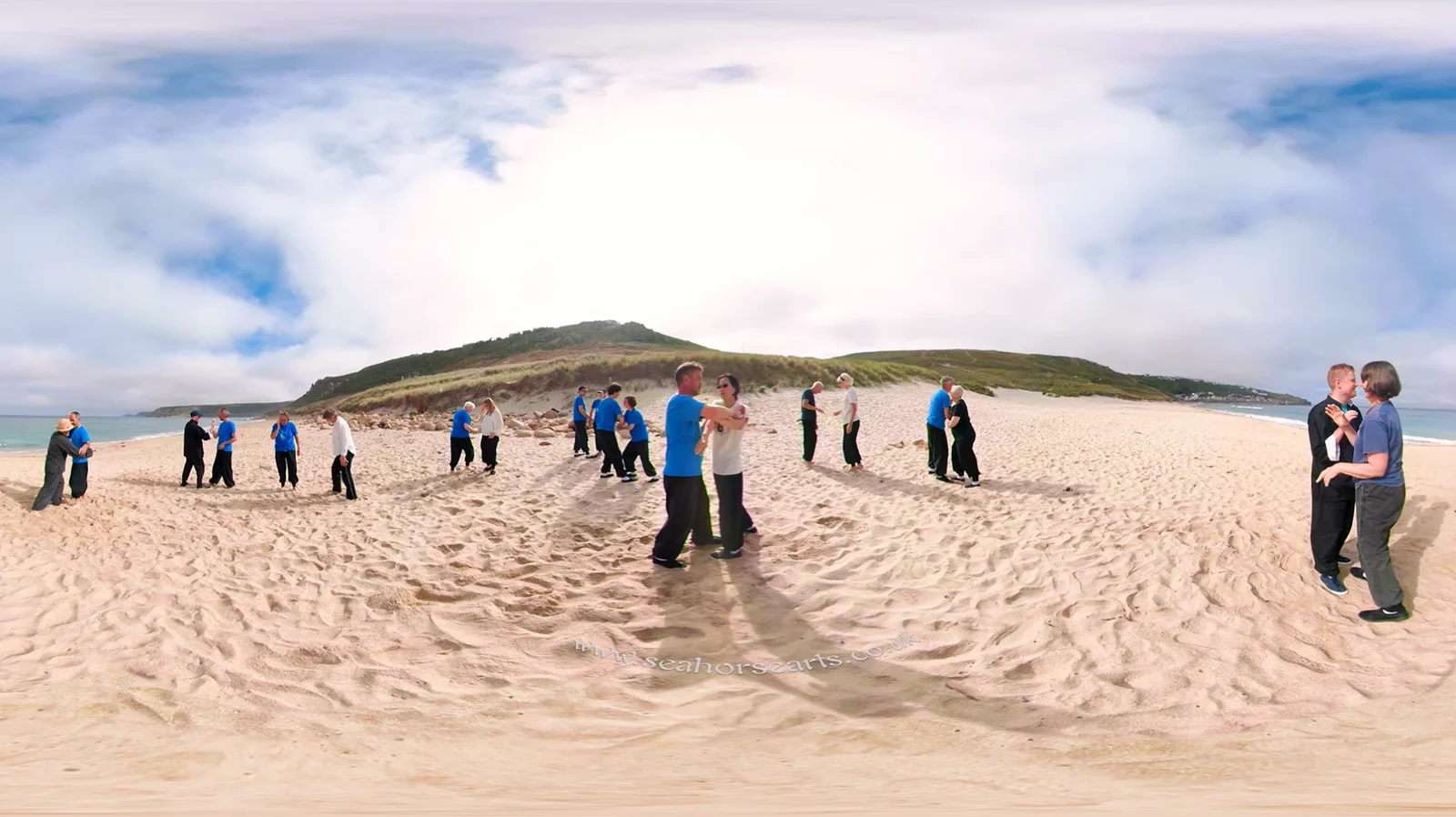
Sticky Hands, also known as Yīfù shǒu (依附手), is one of the classic partner exercises in Lee Style Tai Chi. We teach it to beginners early on, because it introduces the principles of Tai Chi and prepares you for more advanced work. It looks simple, but there is a lot in it.
What you do
Two people stand facing each other and touch on the back of the wrist. They then begin to move their arms and bodies together in slow, spiralling movements, each following the other and keeping the connection unbroken. The aim is to stay soft, stay in touch and notice what is happening. You maintain your balance, meanwhile uprooting your partner but the golden rule is you cannot use force to do it.
Developing sensitivity
Because you are always in contact, you learn to read your partner through your hands: where their weight is, which way they intend to move, and when they are about to change. That takes real sensitivity to their movements and intentions, and it is a skill you can only build by doing it. It’s like an unspoken language, the movements are like suggestions and responses, it’s two way and you get real live feedback with everything you do.
Cultivating qi
Staying connected to a partner also teaches you to circulate your own qi, and to use it to guide the movement between you. The spiralling movements help the flow of energy through the body and link the upper and lower body together. The exercise wporks on a Taoist principle called Wuwei which means non-doing, it’s a less is more type of philosophy that allows your natural responses to take over instead of the conscious mind. When you relax and concentrate in this way while still adapting to the changes of a real interactive situation it develops your Qi flow.
Timing and the mind
You also have to move in time with your partner and keep a steady rhythm, which needs concentration and teaches you a sense of timing that carries into the rest of your Tai Chi. There is a mental side as well. You have to stay present, let go of distracting thoughts and remain calm when your partner pushes at you. Many people find that this calming ability carries over into work, relationships and everyday life.
The five principles
- Yielding. Let your partner’s energy come in without resisting or pushing back. Soften your joints and go with the push, like a tree bending in the wind instead of breaking.
- Listening. Pay close attention to your partner’s movements and respond to them, like a dance partner. Try to read their intentions, as a detective would.
- Sticking. Keep contact and follow when your partner moves, with your hands and your body. Think of two magnets, attracting and releasing while staying connected.
- Neutralising. Redirect your partner’s energy so you avoid being trapped and losing your root, circulate it trying various directions and see the effect.
- Rooting. Stay grounded and stable, like a tree with deep roots. It is what lets you do the other four without being pushed off balance.
What it does for your Tai Chi
A partner finds the stiff places in your body very quickly, so your balance and rooting improve. Yielding to a push makes you more flexible and loosens your joints, and learning to relax and breathe while someone pushes at you reduces stress. The skills carry straight back into your solo practice, where your movements become more aware and more fluid, and you start to see what the movements are for, including their self defence applications. Solo work and partner work balance each other, just like yin and yang.
The funny side
Tai Chi is a serious practice, but it doesn’t have to be solemn, and Sticky Hands is where most of the laughter in class happens. Sooner or later you will meet these three partners:
- The wobbly partner is less stable than a Jenga tower. Stay steady and gentle, because you may both be trying to find your balance at the same time.
- The overly aggressive partner seems determined to push you across the room. Resisting is tempting, but it is the opposite of the exercise. Yield and redirect, and if all else fails, a well-timed tickle will usually defuse the tension.
- The distracted partner is checking their phone or daydreaming about lunch. Bring their attention back gently, or use it as practice for your own sensitivity and adaptability.
If you are trying it for the first time
- Go slowly and use as little force as you can.
- Tell your partner if anything hurts, and ease off if they tell you.
- Swap partners often. Everyone feels different.
- Expect to feel clumsy at first. Everyone does.
Sticky Hands is where Tai Chi stops being something you do on your own. It teaches you sensitivity, balance and patience, and it will probably make you laugh at yourself along the way. Come along and try it. Everyone in the room was a beginner once.
Leave a Reply