Author: Chris

  • Sticky hands

    Sticky hands

    Sticky Hands, also known as Yīfù shǒu (依附手), is one of the classic partner exercises in Lee Style Tai Chi. We teach it to beginners early on, because it introduces the principles of Tai Chi and prepares you for more advanced work. It looks simple, but there is a lot in it.

    What you do

    Two people stand facing each other and touch on the back of the wrist. They then begin to move their arms and bodies together in slow, spiralling movements, each following the other and keeping the connection unbroken. The aim is to stay soft, stay in touch and notice what is happening. You maintain your balance, meanwhile uprooting your partner but the golden rule is you cannot use force to do it.

    Developing sensitivity

    Because you are always in contact, you learn to read your partner through your hands: where their weight is, which way they intend to move, and when they are about to change. That takes real sensitivity to their movements and intentions, and it is a skill you can only build by doing it. It’s like an unspoken language, the movements are like suggestions and responses, it’s two way and you get real live feedback with everything you do.

    Cultivating qi

    Staying connected to a partner also teaches you to circulate your own qi, and to use it to guide the movement between you. The spiralling movements help the flow of energy through the body and link the upper and lower body together. The exercise wporks on a Taoist principle called Wuwei which means non-doing, it’s a less is more type of philosophy that allows your natural responses to take over instead of the conscious mind. When you relax and concentrate in this way while still adapting to the changes of a real interactive situation it develops your Qi flow.

    Timing and the mind

    You also have to move in time with your partner and keep a steady rhythm, which needs concentration and teaches you a sense of timing that carries into the rest of your Tai Chi. There is a mental side as well. You have to stay present, let go of distracting thoughts and remain calm when your partner pushes at you. Many people find that this calming ability carries over into work, relationships and everyday life.

    The five principles

    1. Yielding. Let your partner’s energy come in without resisting or pushing back. Soften your joints and go with the push, like a tree bending in the wind instead of breaking.
    2. Listening. Pay close attention to your partner’s movements and respond to them, like a dance partner. Try to read their intentions, as a detective would.
    3. Sticking. Keep contact and follow when your partner moves, with your hands and your body. Think of two magnets, attracting and releasing while staying connected.
    4. Neutralising. Redirect your partner’s energy so you avoid being trapped and losing your root, circulate it trying various directions and see the effect.
    5. Rooting. Stay grounded and stable, like a tree with deep roots. It is what lets you do the other four without being pushed off balance.

    What it does for your Tai Chi

    A partner finds the stiff places in your body very quickly, so your balance and rooting improve. Yielding to a push makes you more flexible and loosens your joints, and learning to relax and breathe while someone pushes at you reduces stress. The skills carry straight back into your solo practice, where your movements become more aware and more fluid, and you start to see what the movements are for, including their self defence applications. Solo work and partner work balance each other, just like yin and yang.

    The funny side

    Tai Chi is a serious practice, but it doesn’t have to be solemn, and Sticky Hands is where most of the laughter in class happens. Sooner or later you will meet these three partners:

    1. The wobbly partner is less stable than a Jenga tower. Stay steady and gentle, because you may both be trying to find your balance at the same time.
    2. The overly aggressive partner seems determined to push you across the room. Resisting is tempting, but it is the opposite of the exercise. Yield and redirect, and if all else fails, a well-timed tickle will usually defuse the tension.
    3. The distracted partner is checking their phone or daydreaming about lunch. Bring their attention back gently, or use it as practice for your own sensitivity and adaptability.

    If you are trying it for the first time

    • Go slowly and use as little force as you can.
    • Tell your partner if anything hurts, and ease off if they tell you.
    • Swap partners often. Everyone feels different.
    • Expect to feel clumsy at first. Everyone does.

    Sticky Hands is where Tai Chi stops being something you do on your own. It teaches you sensitivity, balance and patience, and it will probably make you laugh at yourself along the way. Come along and try it. Everyone in the room was a beginner once.

  • Wuwei

    Wuwei

    Wuwei (无为), often translated as “non-action”, is a fundamental concept in Taoist philosophy and plays an important role in the practice of Tai Chi. It may sound like doing nothing, but wuwei is actually a way of acting without forcing or interfering with natural processes. In this post we explore wuwei through the works of the ancient Taoist philosophers Liezi, Zhuangzi and Laozi.

    Understanding Wuwei

    At its core, wuwei is about letting go of the ego and allowing things to unfold naturally, without our intervention. It means being aware enough to respond to situations appropriately, without creating resistance or conflict. It is not about being passive, but about actively engaging with the world in a way that is aligned with the flow of nature.

    According to Taoist philosophy, all things arise from the Tao, or the Way, the ultimate reality that transcends all dualities. The Tao cannot be described in words, but it can be experienced through direct intuition. To live in harmony with the Tao, we must let go of our desires, judgements and attachments, and be guided by the natural order of things.

    Wuwei is a practical concept as well as a philosophical one. It can be seen in the way we move, breathe and interact with others. In Tai Chi, the goal is not to force the movements or achieve a specific outcome, but to allow them to emerge spontaneously from within.

    Wuwei in Action

    To illustrate wuwei, let’s look at some stories from ancient Taoist philosophers.

    Liezi

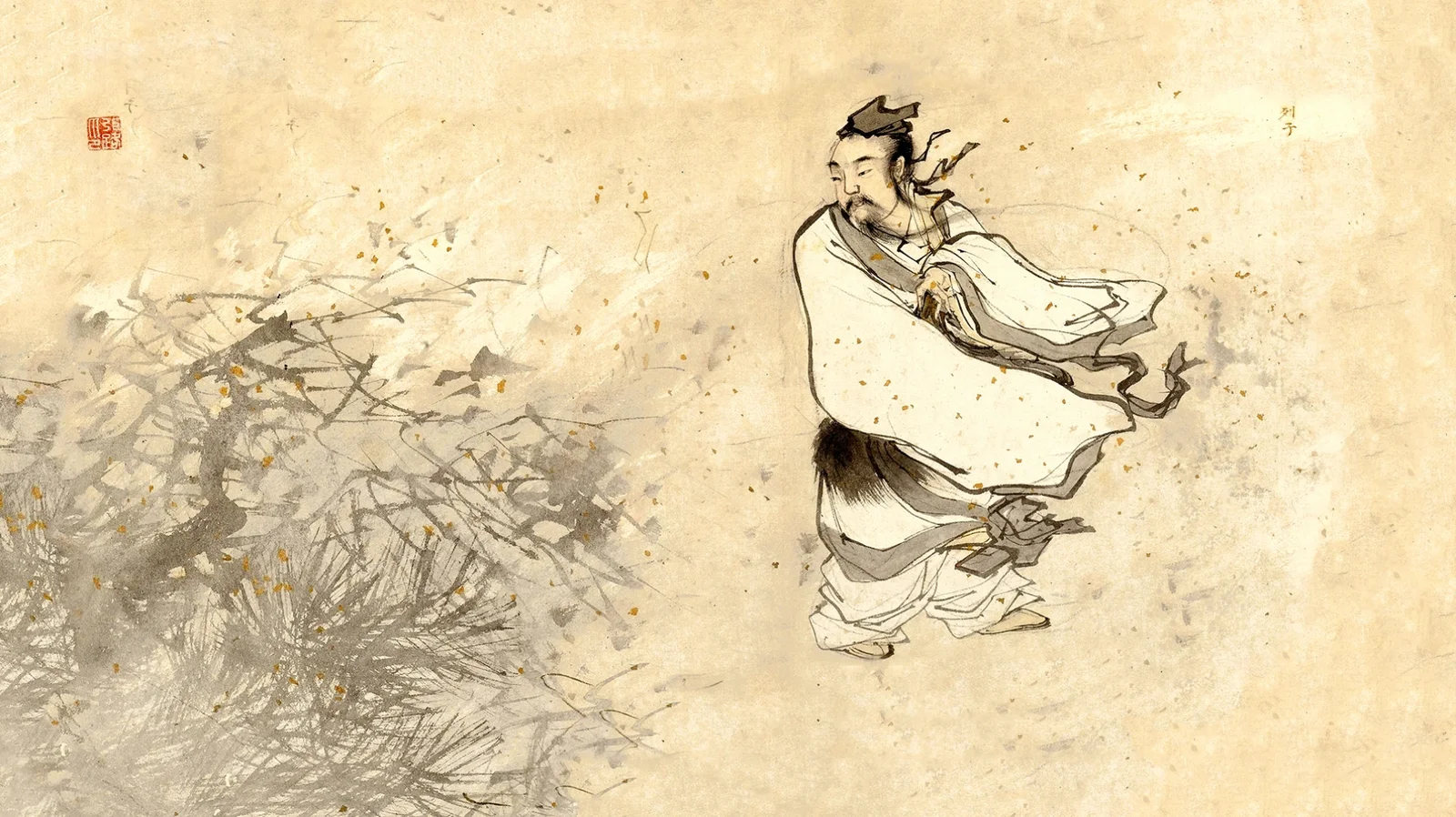
    In the Liezi1 there is a story about Liezi riding the wind.

    ‘At the end of nine years my mind gave free rein to its reflections, my mouth free passage to its speech. Of right and wrong, profit and loss, I had no knowledge, either as touching myself or others. I knew neither that the Master was my instructor, nor that the other man was my friend. Internal and External were blended together into Unity. After that, there was no distinction between eye and ear, ear and nose, nose and mouth: all were the same. My mind was frozen, my body in dissolution, my flesh and bones all melted together. I was wholly unconscious of what my body was resting on, or what was under my feet. I was borne this way and that on the wind, like dry chaff or leaves falling from a tree. I knew not whether the wind was riding on me or I on the wind. Now, you have not spent one whole season in your teacher’s house, and yet you have lost patience two or three times already. {p. 40} Why, at this rate, the atmosphere will never support an atom of your body, and even the earth will be unequal to the weight of one of your limbs!

    (The only way to etherealize the body being to purge the mind of its passions.)

    How can you expect to walk in the void or to be chariotted on the wind?’

    In the story, Liezi has spent nine years practising meditation and cultivating his mind and body. Having let go of his ego and desires, he achieves emptiness and unity with nature, and can ride the wind effortlessly, without resistance or struggle.

    Yin Sheng, on the other hand, is still a novice. He is easily frustrated and loses patience, which goes against the Taoist principle of non-action. Liezi reminds him that he needs to purge his mind of passions and desires to reach the emptiness that is essential to wuwei. The story shows that wuwei is not a passive or lazy approach to life, but an active and focused way of being that aligns us with the natural flow of the universe.

    Zhuangzi

    Zhuangzi was a Taoist philosopher famous for his sense of humour. In the Zhuangzi2 there is a story about a man and his fighting rooster.

    There once was a man who wanted his fighting rooster to be more ferocious. He took the rooster to a trainer. In a few weeks’ time he returned and saw that his rooster didn’t squawk as loudly.

    “Not ready yet,” said the trainer. Two weeks later he saw that his rooster barely raised his neck feathers and wings.

    “Not ready yet,” said the trainer. Another week passed. His rooster looked as tame and docile as a chick.

    “You’ve ruined my fine fighting bird!” screamed the man at the trainer.

    “Not at all,” the trainer replied, “See how calm and secure he is, how serenely strong he stands today. The other fighting birds take one look at him and they all run away!”

    This story illustrates wuwei as less is more. Rather than making a fuss and drama, calmness and serenity prevail. This is a quality cultivated by the masters of martial arts above all else: to keep your head and avoid panic. The other birds cannot fathom the trained bird. They see only nothingness, no fear and no anger, and they flee.

    Laozi

    Laozi wrote the most famous book of Taoism, the Tao Te Ching, but paradoxically began it by saying that the Tao that can be put into words is not the true Tao.

    One example of wuwei in the Tao Te Ching3 is in Chapter 17, where it is said:

    “The best leaders are those the people hardly know exist.
    The next best is a leader who is loved and praised.
    Next comes the one who is feared.
    The worst one is despised.”

    This suggests that the most effective leaders are those who act with wuwei, not drawing attention to themselves or forcing their will upon others. They allow things to unfold naturally and lead by example, without seeking personal glory or control. This way of leading is harmonious and beneficial for both the leader and the people they serve.

    Cooking a small fish is another example of wuwei in the Tao Te Ching. In Chapter 64, it is said:

    “A kingdom is like a great, low-lying river, The point where all the streams and torrents in the world converge. If you can keep centered and true, The kingdom will be centered and true. With Wuwei, the whole kingdom is refreshed, Without Wuwei, the kingdom becomes weary and oppressed.

    Just as a small fish should not be over-handled, The ruler must not over-manage the people with force. In this way, the Tao of Heaven is reflected in the land, And all things flourish without being commanded.”

    Just as a small fish should not be over-handled when cooking, a leader should not try to control or manipulate their people too much. By trusting the natural order of things, the kingdom is refreshed and all things flourish without the need for force or excessive intervention.

    Wuwei in Tai Chi

    Rather than forcing the body into a specific position, Tai Chi practitioners allow movements to arise spontaneously from within. In doing so, they develop a deep awareness of, and sensitivity to, the flow of energy within the body and the environment.

    Regular practice brings a sense of ease and relaxation, reduces stress and promotes overall wellbeing. Tai Chi has been shown to improve balance, flexibility and cardiovascular health, and to reduce symptoms of anxiety and depression. Research also suggests it can reduce inflammation: in one study, participants who practised Tai Chi regularly for 12 weeks showed a significant reduction in inflammation compared with a control group.

    In ancient Chinese medicine, based on Taoism, mind and body are viewed as two aspects of a whole. By reducing mental stress, the body can allocate more time and energy to repair and rejuvenation, resulting in less wear and tear on the system.

    Tai Chi also has a meditative aspect. By focusing on the movements and the breath, practitioners quiet the mind and enter a state of deep relaxation, which can be particularly beneficial for anxiety and stress-related disorders. With regular practice, this state of calm can become a habitual state of mind.

    Wuwei in Daily Life

    The principles of non-action can be applied to all areas of our lives. Here are three ways to begin.

    Awareness. Be fully present in the moment, without judgement or distraction. By noticing our thoughts, feelings and surroundings, we can respond to situations with greater clarity and equanimity.

    Acceptance. Let go of attachment to outcomes. Rather than trying to control every aspect of our lives, we can learn to trust the natural order of things and be guided by it.

    Playfulness and curiosity. Approach situations with openness, let go of expectations and allow yourself to be surprised by the unexpected.

    Wuwei and mindfulness

    Wuwei can also be translated as “no-mind” or “non-intentional action”, implying a state of mind free from attachment, distraction and mental chatter, in which our actions flow effortlessly and spontaneously, without self-consciousness or deliberate effort.

    In this sense, wuwei goes beyond mindfulness, which may still involve a degree of intentional focus or mental effort. But wuwei is not about “doing nothing” or being passive. It is about acting in harmony with the natural flow of the universe, without imposing our own will or agenda on the world around us. In Tai Chi, we allow our movements to arise naturally and effortlessly, while staying actively engaged and focused in the present moment.

    Conclusion

    Wuwei is a fundamental concept in Taoist philosophy and has an important role in the practice of Tai Chi. It involves letting go of our ego and allowing things to unfold naturally, without our intervention. Through regular practice, we can develop a deep awareness of the natural flow of energy within the body and the environment, reduce stress and cultivate a sense of inner peace and calm. By practising awareness, acceptance and playfulness in daily life, we can bring that same ease, harmony and balance to everything we do.

    References:

    1. TAOIST TEACHINGS Translated from the Book of Lieh-Tzü with Introduction and Notes by LIONEL GILES M.A., D.Litt. [1912] https://www.sacred-texts.com/tao/tt/tt05.htm
    2. Zhuangzi. Translated by James Legge
    3. Laozi. Tao Te Ching. The Sayings of Lao Tzu by Lionel Giles [1905] https://www.sacred-texts.com/tao/salt/index.htm

  • The biggest ever Tai Chi review

    The biggest ever Tai Chi review

    Here’s a number to sit with: more than 1.7 billion people live with a musculoskeletal condition. It’s the leading cause of disability on the planet, and low back pain alone tops the list in 160 countries.

    Meanwhile, a slow, quiet practice that people have done in parks at dawn for centuries has just been put under the microscope, and it held up better than you might expect.

    The biggest look yet

    A new paper in the British Journal of Sports Medicine took on a problem that has dogged Tai Chi research for years: lots of studies, patchy results, no clear overall picture. The authors ran no new trial. They gathered 92 existing meta-analyses, drawing on 1,744 randomised controlled trials, and graded the strength of the evidence for 547 different outcomes. Tai Chi was the biggest single category, alongside Qigong, Baduanjin, Wuqinxi and Yijinjing.

    The headline findings for Tai Chi reached high certainty:

    • Better physical function in knee osteoarthritis
    • Better mental health in neck pain
    • Better sleep in fibromyalgia
    • Stronger bones in osteoporosis

    Pain and stiffness eased in several conditions too.

    The sweet spot, according to the reporting: more than six months, at least three times a week, around 150 minutes in total each week. Not heroic. Just steady.

    Now the reality check

    I’d rather tell you this than have you find out from a sceptical friend. Only 23 of those 547 findings (4.2%) reached high certainty, and 179 (32.7%) moderate. The rest were weaker. About 71% of the included reviews were rated high quality. The paper calls these exercises safe, but it doesn’t seem to pool adverse events separately, and the authors are asking for bigger, longer trials.

    So: strong evidence for specific things, promising evidence for plenty more, and no miracle cure.

    The part that made me put the paper down

    Every one of those trials asked the same kind of question: does this help people who already have the problem? That’s good, rigorous science. It’s also exactly the question the Huang Di Nei Jing says is the wrong one to start with.

    That text is thousands of years old, and one passage in the Su Wen has stayed with me. The wise physician, it says, works before illness arrives. Don’t dig the well once you’re thirsty. Don’t start forging your weapons on the way into battle. By then, it’s too late. The sages taught people who weren’t yet ill, because treating a disease that has already taken hold is the slow, costly way round.

    The same page lays out the logic behind it. Live in step with the seasons, with yin and yang, and you stay free of strange diseases. Go against that rhythm, and you wear yourself down from the inside. It’s a whole philosophy of health built on not getting there in the first place.

    Two very different yardsticks

    Western medicine measures what it can count: pain scores, joint function, bone density, hours of sleep. That rigour is a strength, and I’m not knocking it.

    But Tai Chi wasn’t designed to treat knee osteoarthritis. In the Chinese tradition, you practise it to cultivate qi and keep it flowing, to stay supple and settled. Building muscular strength isn’t the aim. A trial that scores it like physiotherapy is judging it by a yardstick it wasn’t made for. Perhaps that’s why the benefits that show up are so broad: function, sleep, mood, bones. Those are the fruits you’d expect from a practice aimed at balance, not bulk.

    A few honest limits. The Neijing predates Tai Chi by many centuries, so the link is one of philosophy, not lineage. The page I’ve been reading talks about living with the seasons, not about exercise or diet. The wider tradition does treat how you eat, rest and move as part of one picture, but that’s the tradition speaking, not a trial result. And science hasn’t confirmed qi as something measurable. Better sleep in fibromyalgia doesn’t prove the classical theory behind it.

    But look where the two approaches land. Gentle, regular practice, kept up over months and years, seems to matter. The review’s authors even suggest community and primary care as a natural home for these exercises, in the name of healthy ageing and chronic disease prevention. The Neijing would nod along.

    The study nobody’s run yet

    Here’s what I’d love to see: big, long trials of people who don’t yet have these conditions, testing whether regular practice, alongside decent food, rest and rhythm, keeps them at bay. That would be digging the well before the thirst. It would also be a genuine meeting of East and West.

    Your move

    If you have a musculoskeletal condition, check with your GP or physio before starting anything new. Otherwise, the message from both the trials and the text is the same: don’t wait until you’re thirsty. Come and try a class, slow down, and keep turning up.


    Sources

    • Chen W-X et al., “Efficacy and evidence certainty of traditional Chinese exercises for musculoskeletal disorders: an umbrella review of meta-analyses,” British Journal of Sports Medicine, 2026. doi:10.1136/bjsports-2026-111792 (PubMed)
    • Huang Di Nei Jing Su Wen, in Ilza Veith’s translation, p. 105.
  • Autumn term in Falmouth

    Autumn term in Falmouth

    Tai Chi in Falmouth: a new term starts this October.

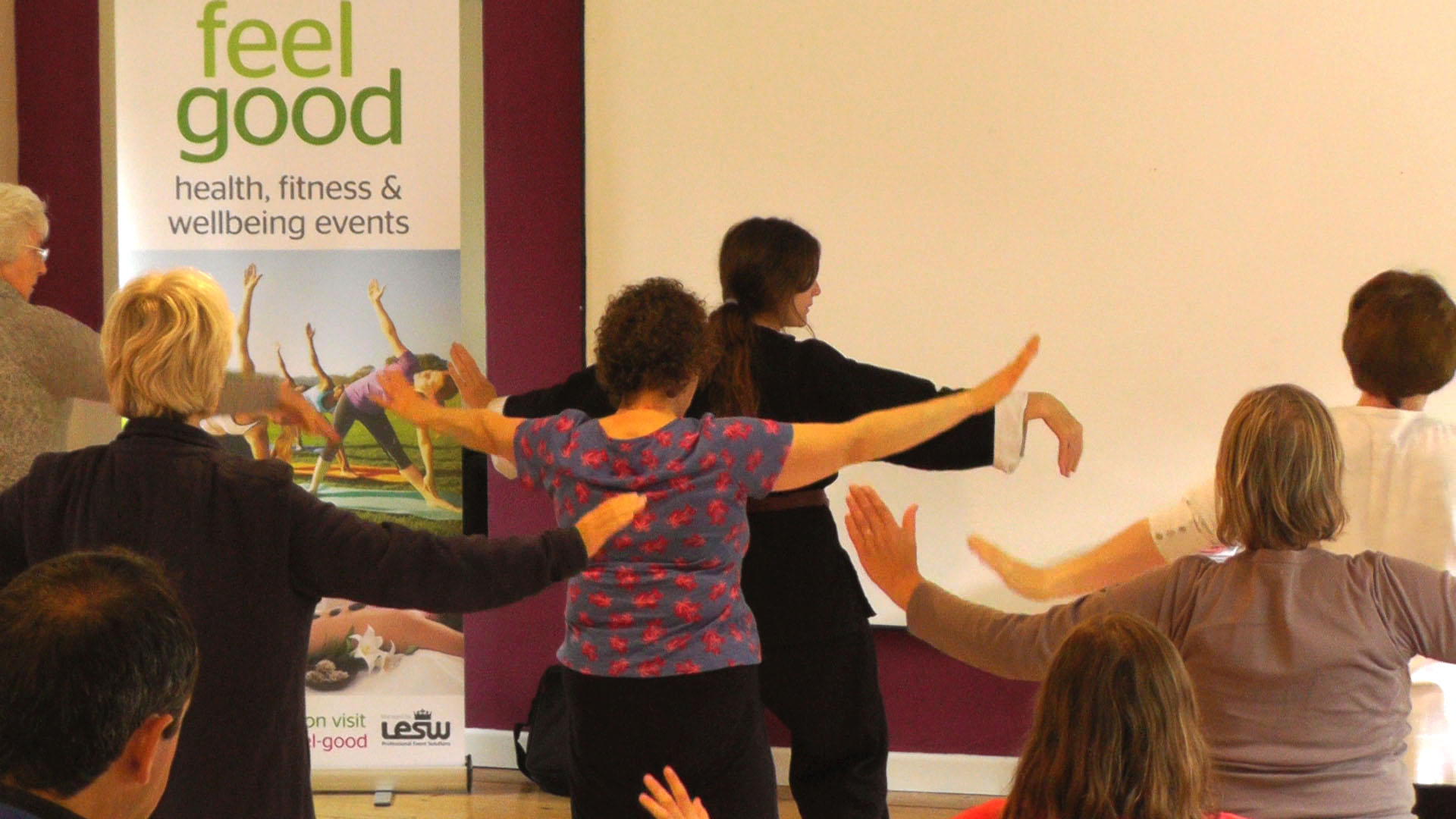
    If you’ve been meaning to try Tai Chi, this is a good moment. Our Falmouth Tai Chi Club starts a new ten-week term this Wednesday evening, and everyone is welcome, whether you’re a student, a beginner, or coming back after a break.

    Why start Tai Chi?

    Tai Chi is slow, gentle movement with relaxed breathing, sometimes called moving meditation. It’s low-impact, so you don’t need to be fit or flexible to begin. Many people find it:

    • helps them unwind after a long day or a heavy week of study
    • improves balance, posture and flexibility
    • leaves them feeling calmer, with more energy
    • gives them a regular evening in good company

    It suits all ages and fitness levels. It’s especially good for students, because it fits around a busy timetable and gives you a proper break from the screen.

    The details

    • When: Wednesdays, 7-8:30pm
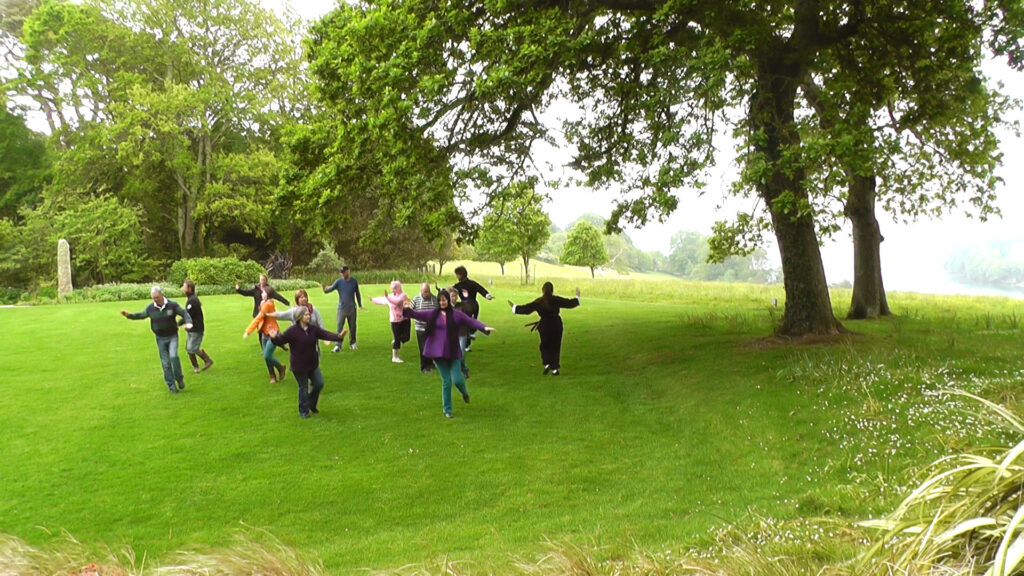
    • Where: Falmouth Primary Academy, Jubilee Road, Falmouth, TR11 2BB (there’s a car park, and a field when the weather is warmer)
    • Taught by: Chris and Rachel and James, who have run many clubs between them
    • What to wear: comfortable clothes and flat shoes

    Tried it and want to stay? You can carry on to the end of the term at a reduced price.

    The longer you stay, the less you pay.

    Ready to commit? Join the term.

    Join part-way through and pay only for the classes still to come. Four months’ TCAA membership is included.

    Not sure yet? Try it. £10 a class.

    Come for a week or two, up to four weeks in a row. Your free trial membership is included.

    Already a member? Log in first

    Recommended products

  • A new venue in Truro

    A new venue in Truro

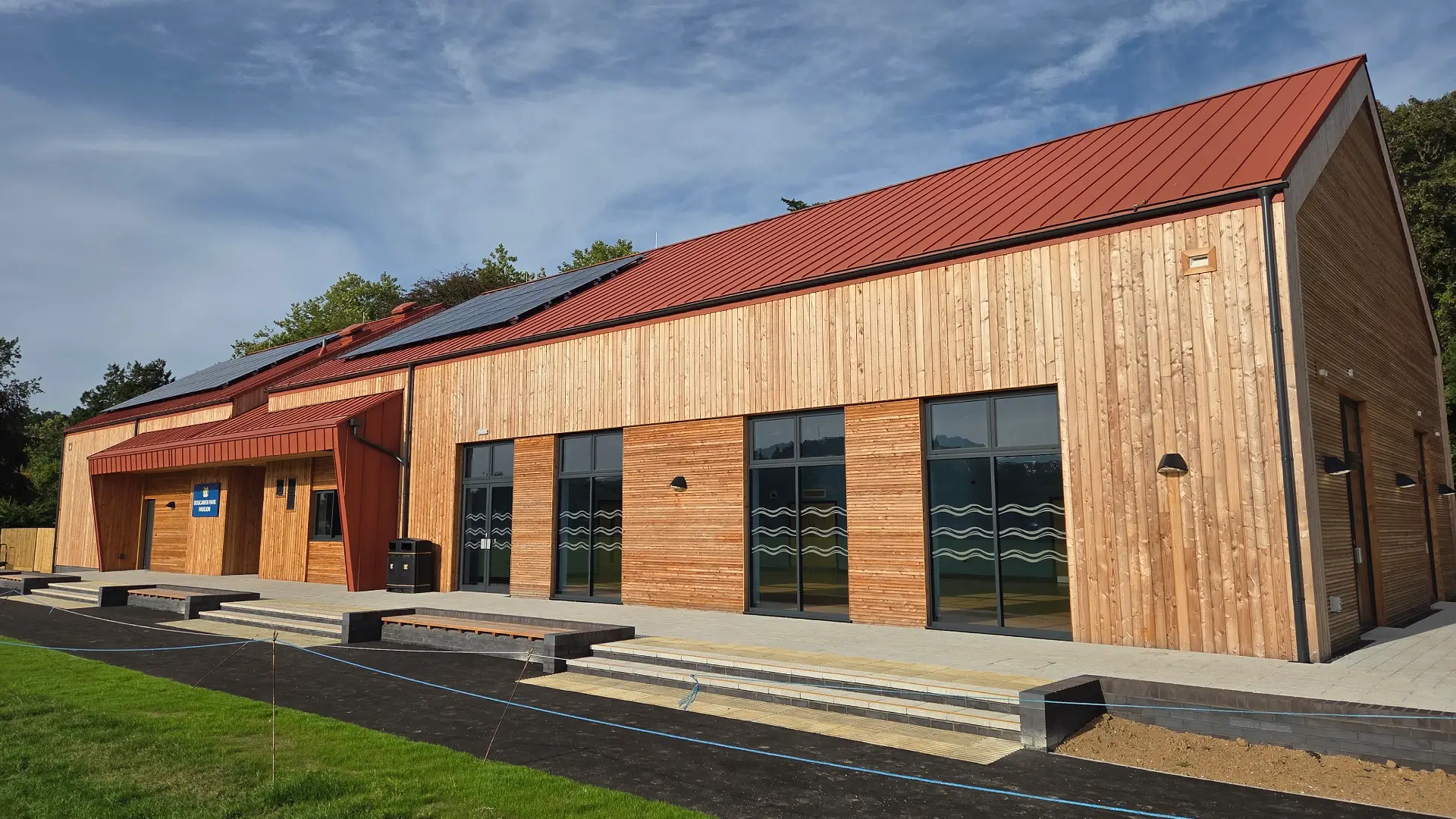
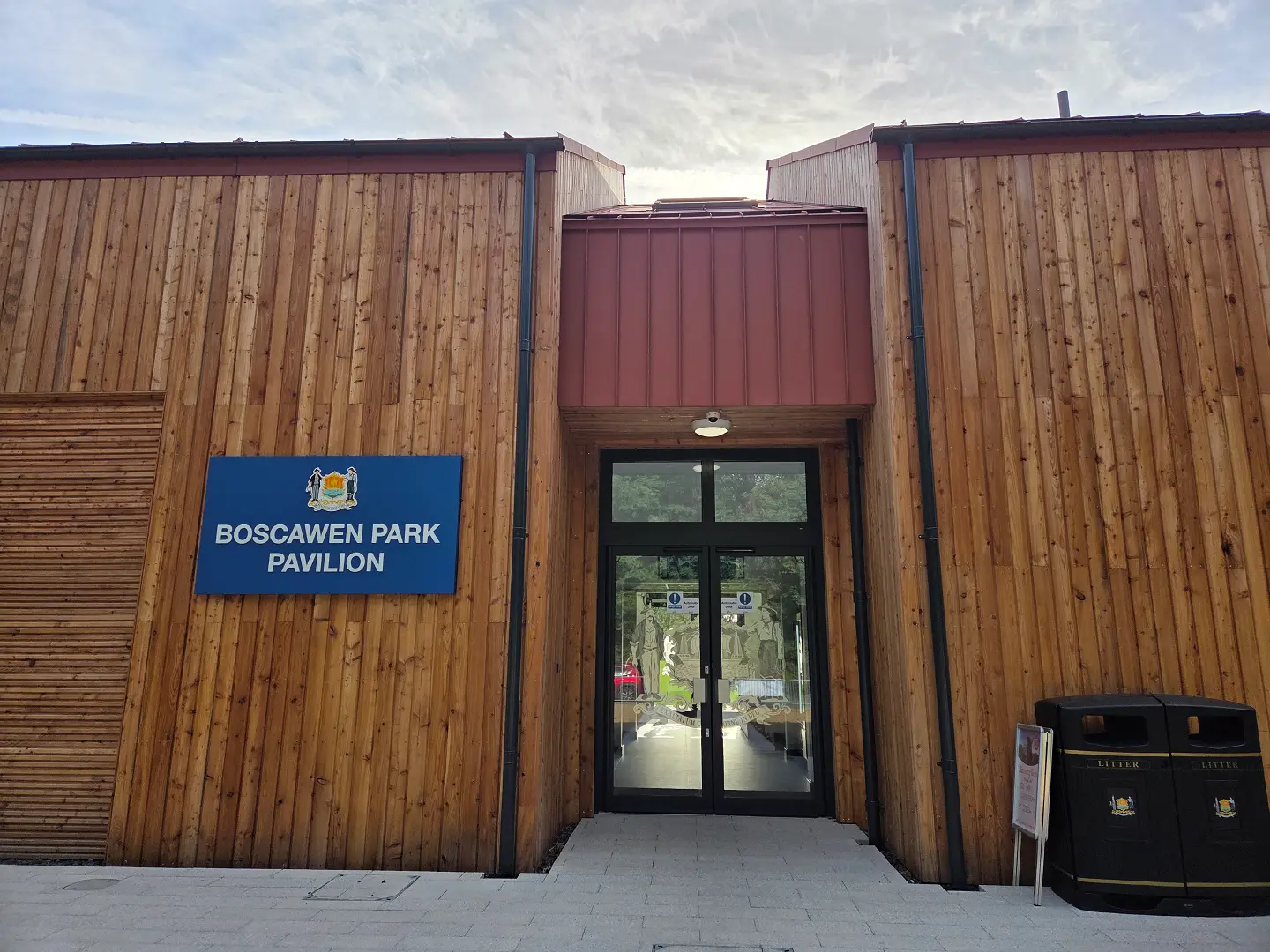
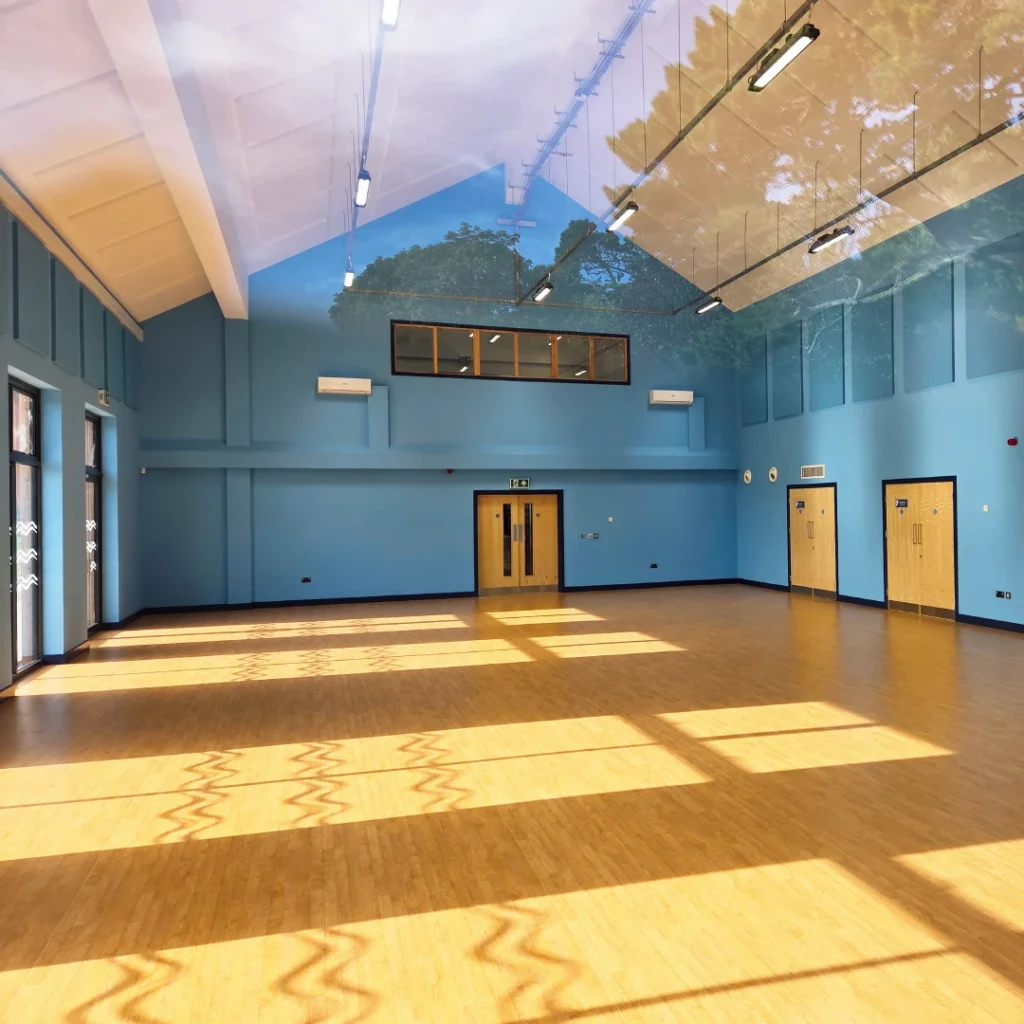
    Boscawen Pavilion, Boscawen Park, Malpas Road, Truro

    Tuesday evenings from 13th October 7-8:30pm

    New Tai Chi & Qigong club starting in Truro next week! 🌿

    Looking for a gentler way to stay active, ease stress and feel more balanced? Come and try Tai Chi and Qigong.

    Tai Chi is often described as “meditation in motion,” a slow, flowing practice that’s kind to the body and calming for the mind. Qigong shares the same roots and the same spirit, using simple, gentle movements, breathing and focus to build and circulate your energy. Think of it as a natural energy boost without the caffeine!

    Both are wonderful for body and mind. Regular practice can help with:

    ✨ Balance, posture and coordination
    ✨ Flexibility and joint mobility
    ✨ Strength, especially in the legs and core
    ✨ Natural energy and vitality
    ✨ Easing stress, tension and everyday anxiety
    ✨ Better sleep and a calmer, clearer mind
    ✨ Sharper focus and mental acuity
    ✨ Stronger willpower and self-discipline
    ✨ A renewed sense of purpose

    Many people find that the steady, mindful rhythm of practice gives them tools for coping with anxiety and a quiet inner strength that carries over into the rest of their week.

    It’s open to men and women of all ages and levels of ability. You don’t need any experience, special clothing or particular level of fitness. Movements can be adapted to suit you, and you can work at your own pace in a friendly, relaxed group.

    Whether you’re completely new or have tried it before, you’ll be very welcome. Details are above, so come along and give it a go!
    Teacher: Chris Simpson

    Book your place now

    Recommended products

  • Tai Chi Summer Course

    Tai Chi Summer Course

    Two Weeks on the Sand: Training at Sennen Cove, Summer 2026

    Tai Chi and Kung Fu beside the sea in Whitesand Bay

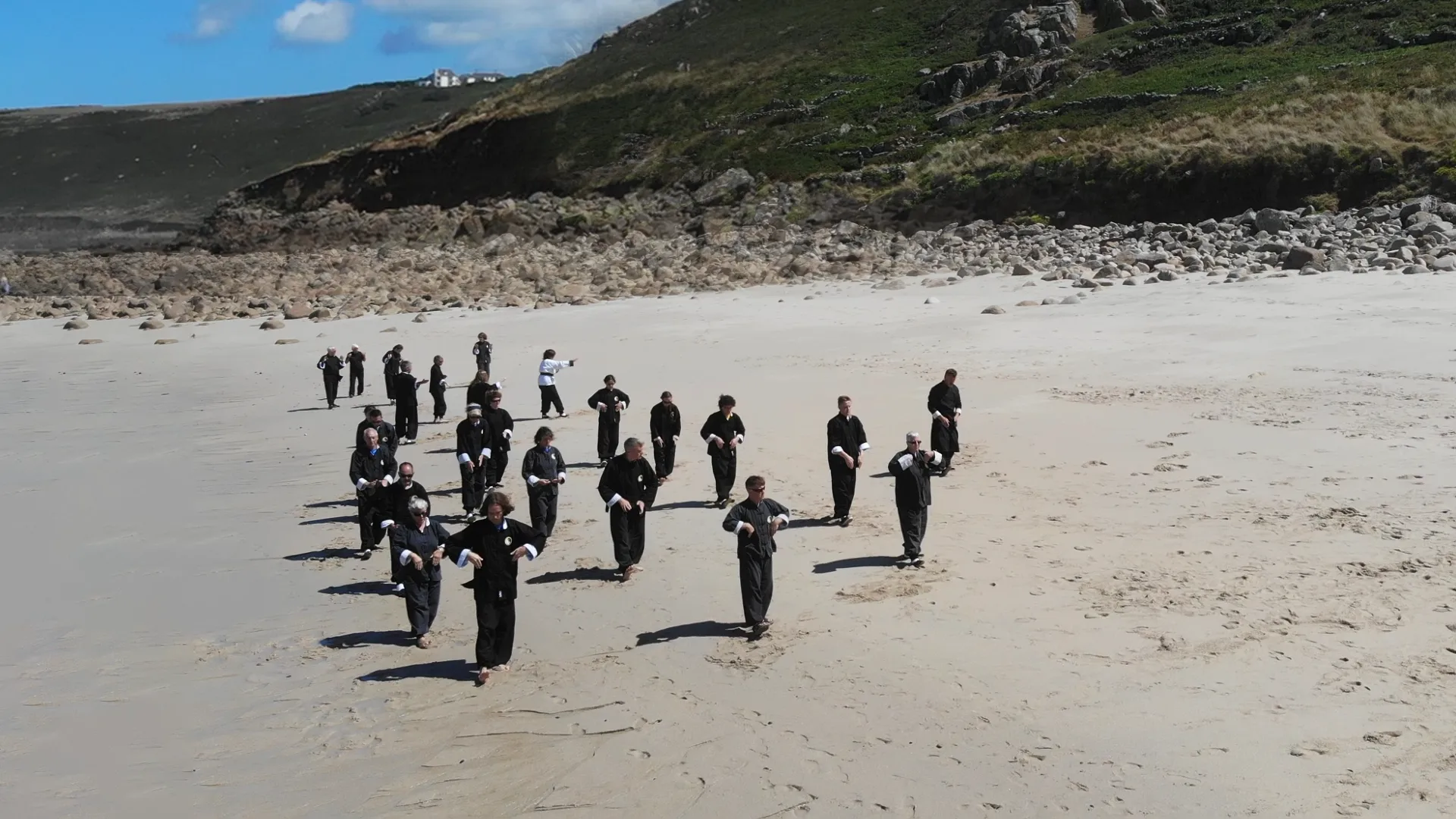
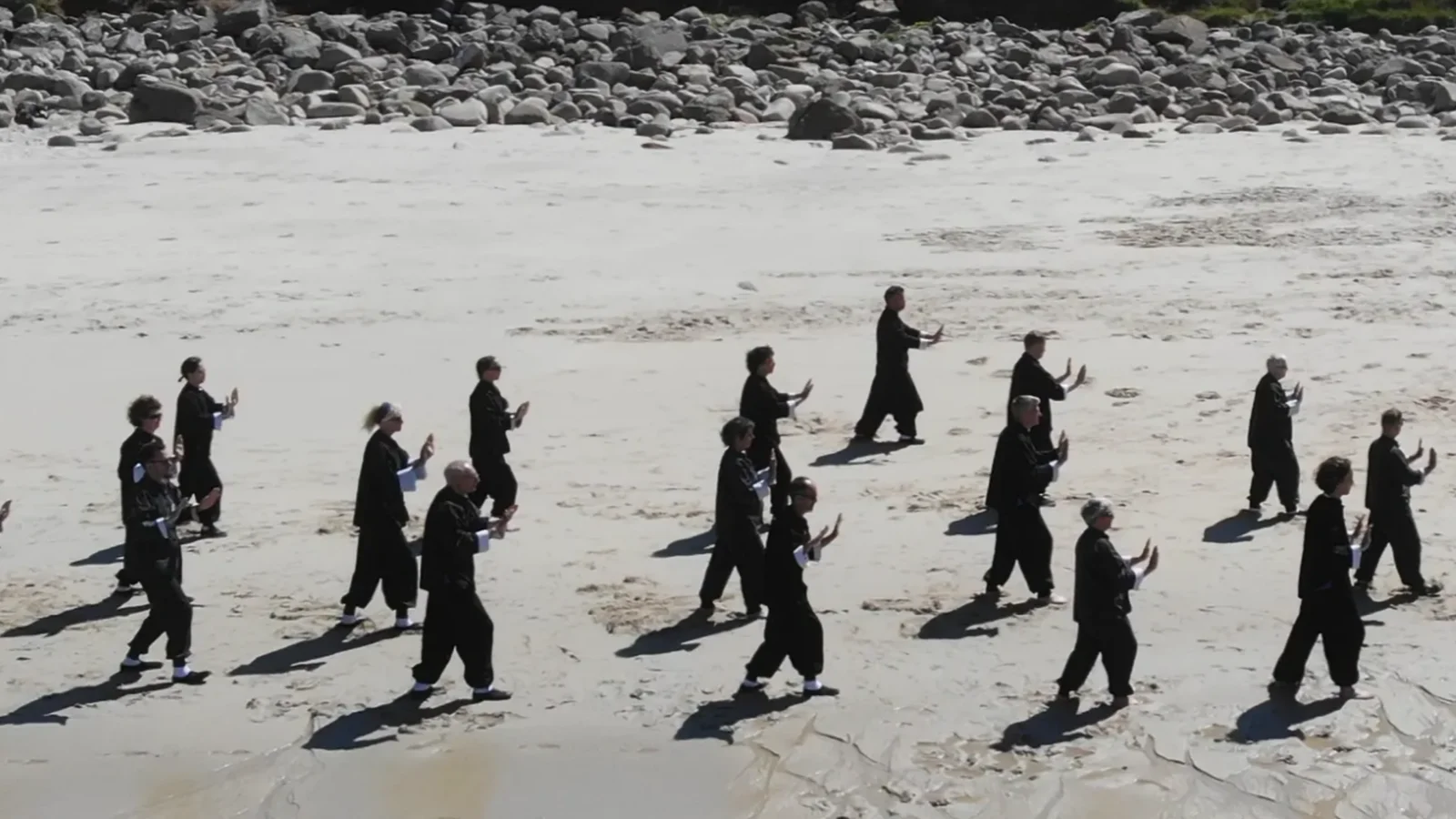
    This summer we moved our training out of the hall and onto the beach. For two weeks in July and August, students and teachers from the Truro, Falmouth and St Agnes classes met at Sennen Cove, on the edge of Whitesand Bay, and trained from morning until late afternoon with the Atlantic in front of us.

    How Cornwall became our summer home

    It started in 2005, when our Easter course at Warwick School was double booked. Lying in the bath, I wondered what would happen if we ran it in Cornwall instead. We had been holidaying here for years, ever since a hurricane flattened our tent in North Devon, so I consulted the I Ching and tossed a coin: heads we go, tails we stay. It came up heads, and it changed our lives.

    We piloted a week-long course based at the St Just Sports Centre, with everyone staying in holiday cottages nearby, and for years afterwards we came back every Easter and for three weeks each summer. In 2010 we booked a cottage by mistake that turned out to be a permanent let. The coin pointed the same way again, and we moved here that September.

    In 2018 a researcher from ITN asked about filming our summer course. Sennen Cove, where we usually finish the course with a beach party, was the obvious setting. The weather held all week and the crew captured wonderful footage for an ITN Tonight documentary on alternatives to painkillers.

    Students from near and far

    Over the years our courses have drawn people from across the country and around the world. This year we welcomed students and teachers from our Cornish clubs, the Midlands, Brighton and Switzerland. Training beside people with different habits and different questions sharpens everyone’s practice.

    Week one: Tai Chi (27 to 31 July)

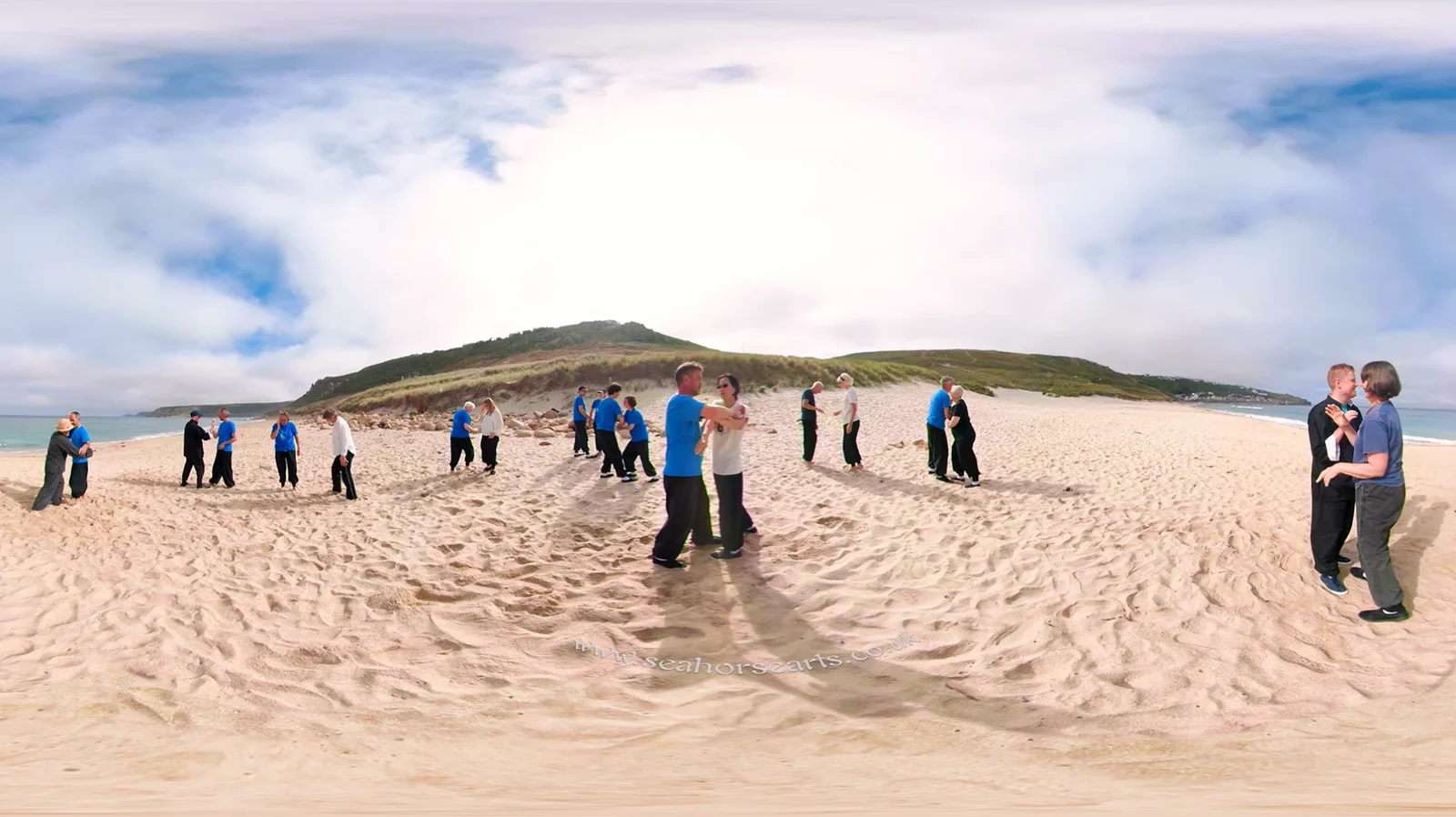
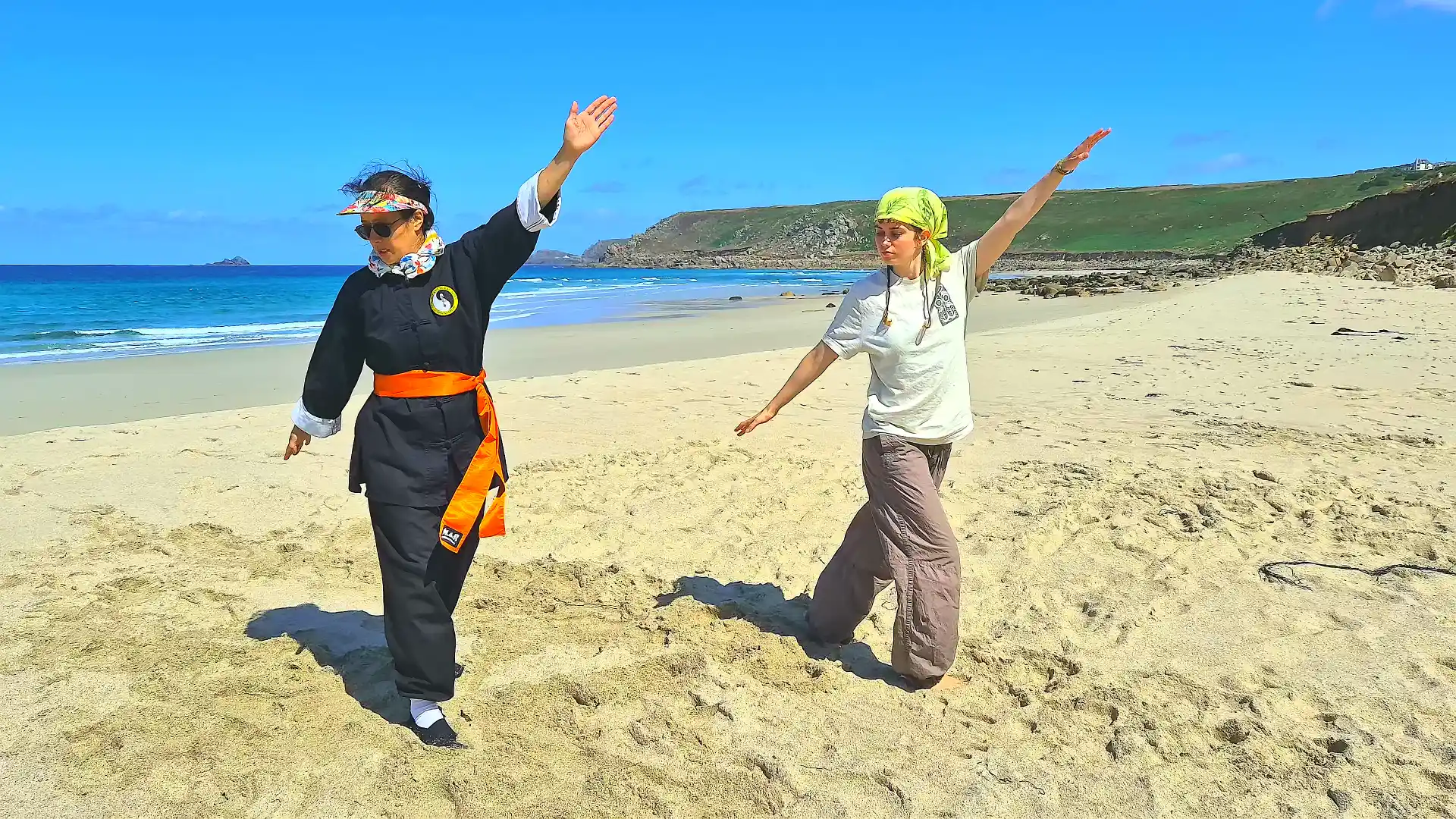
    Tai Chi dance at Whitesand Bay with Bea and Jane

    We worked through the Tai Chi forms and spent a lot of time on sticky hands, the two-person practice of listening, yielding and responding. Sand is a demanding teacher: the ground moves under you, so balance and rooting have to be honest. Bea partnered Jane, a dance graduate from Switzerland, and we were struck by how quickly she grasped the principles of spontaneous movement, or Wuwei.

    The UK heatwave was at its height, but a light haze and patchy cloud kept the beach comfortable. At lunch Bea’s large canopy gave shade, so everyone could rest properly before the afternoon session.

    Week two: Kung Fu, Hand of the Wind (3 to 7 August)

    The second week was mostly for our more experienced students, so we moved into freeform training. Alongside more sticky hands, we took apart techniques that are notoriously hard to get right, such as the rear naked choke. Slowing a technique down, separating its parts and rebuilding it is where real understanding comes from.

    Camping, breakfasts and Cornish food

    Many of us camped at Brea Vean Farm, where the nights were warm and there was no morning dew. We started each day early with a full cooked breakfast, most often at the Dog and Rabbit, and tried other cafés in St Just and Sennen Cove too.

    Evenings were spent around West Penwith: Newlyn, the Mackerel Sky, the Tolcarne Inn, Mousehole, the Coastguard Inn, and a takeaway from the Red Star Beijing in St Just.

    Join us next time

    Whether you are new to Tai Chi, coming back after a break, or already training and ready to go deeper, our courses are built for steady progress over days rather than a single hour. To hear about the next course, get in touch.